





Controlling the spread of pathogens through layout principles, fluid dynamics, and cleanability optimization
The proper design and engineering of hygienic manufacturing equipment prevents biological, chemical, and physical contamination.
While hygienic design has successfully been applied to most elements of food, beverage and pharmaceutical production the adoption of these principles through the floor and drainage environment has been much slower.
Reversing this trend requires a practical implementation of hygienic geometry in systems level drainage through the implementation of several principles:
- Facility layout and drainage integration
- Hydrodynamic flow and internal geometry
- Non-porous and chemically inert materials
- Hygienic welding practices
- Accessibility for inspection and maintenance
When these principles are translated into physical realities, they prevent the growth and spread of bacteria from liquid egress points back into controlled hygienic environments.
Macro-Spatial Drainage and Facility Layout Integration
Hygienic geometry begins at the macro-scale, with the layout of the processing facility and the equipment within it.
Liquids and solids management requires a plumbing layout that takes into account manufacturing process zones, specific flow rates, and the movement of people as well as wheeled equipment.
Adequate drainage must be placed within every zone to prevent the accumulation of standing water or solids on the production floor. This means matching drains to processes to ensure adequate flow rates and solids management.

Drainage system design principles recommend that the flow of wastewater proceed opposite the flow of production. Designing a waste stream flow that moves opposite this process reduces the risks of contamination in ultra high care areas.
Failure to remove liquids from the production floor can result in the spread of bacteria. This occurs through splashing or aerosolization moving contamination from the floor to the production environment.
Drainage system layout is facility specific. Facility layout should be completed by a dedicated engineering team during the design phase and executed rigorously during the construction phase by trained and experienced professionals.
Hydrodynamic Flow and Internal Geometry
While macro-geometry addresses how the environment interacts with drainage, micro-geometry dictates how liquids and solids are processed through the drainage system. A fundamental tenet of hygienic design is that all surfaces must be perfectly self-draining. This dictates that surfaces must be sloped, rounded and designed without undrainable or hollow areas.
Linear Self-Draining Systems
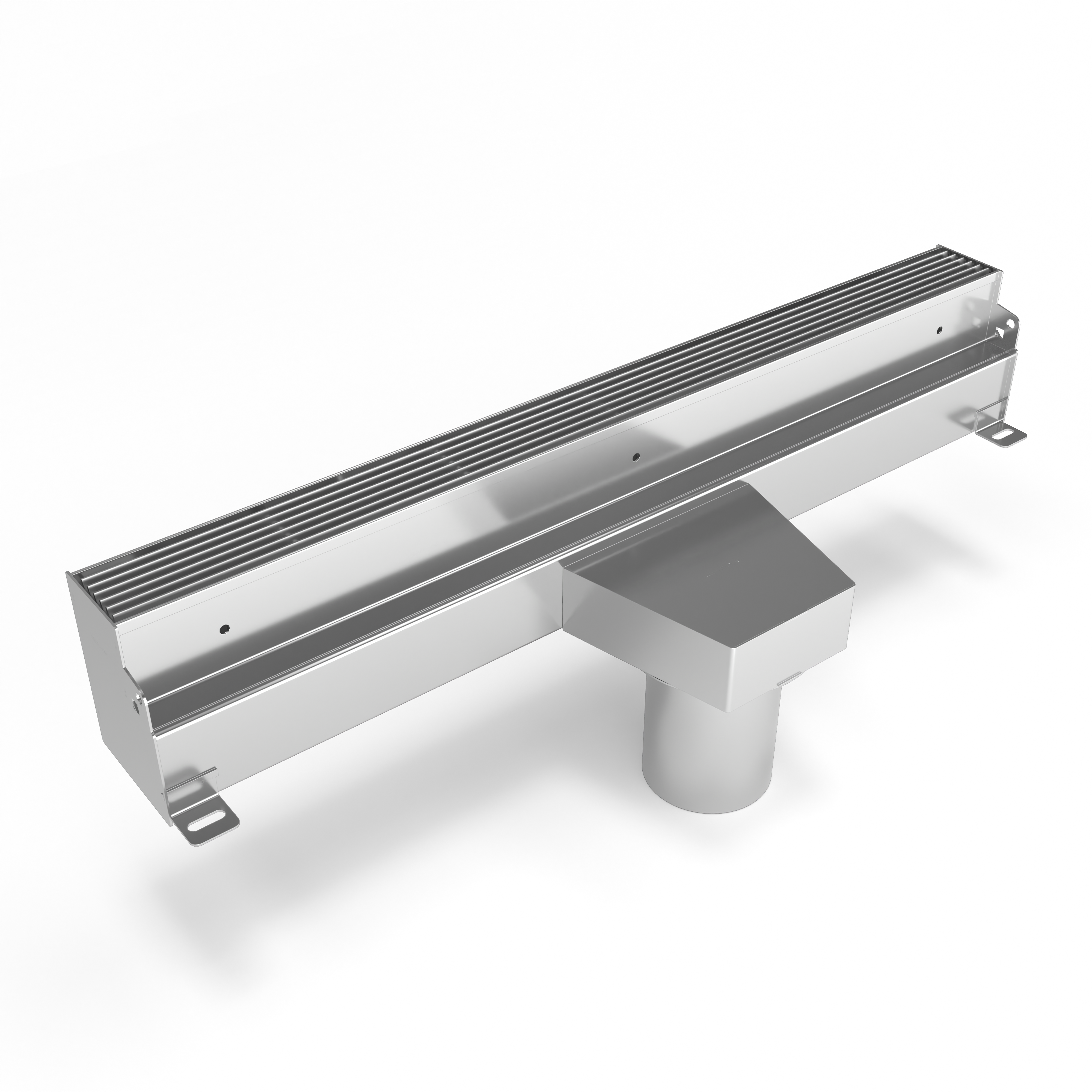
To ensure that the process of self-draining is independent of the facility's floor requires pre-sloped linear drainage systems. This allows the floor to be sloped towards the drainage system while the drainage system is able to slope and drain independent of the floor’s topography. Linear drainage systems are channel drains with inlets that run the length of the drain. This category includes both slot drains and trench drains.

Factory pre-slope in these systems is achieved by dropping the invert depth of the drain body in relation to the inlet. While a not insignificant drop is required engineers must consider the needs of hygienic drainage slope vs. depth requirements over long system runs. A continuous minimum pitch of 1/16 inch per foot of run produces a 0.5% slope suitable for the continuous flow of liquids within the body of the drain.
Internal hygienic geometry of linear and point drains
A hygienic drain must not only passively collect water; it must actively leverage fluid dynamics to continuously propel sediment, organic waste, and viscous chemical solutions toward the outlet. The degree to which a drain is self-cleaning is directly dependent upon leveraging hygienic geometry to generate constant velocity during normal operational flows.

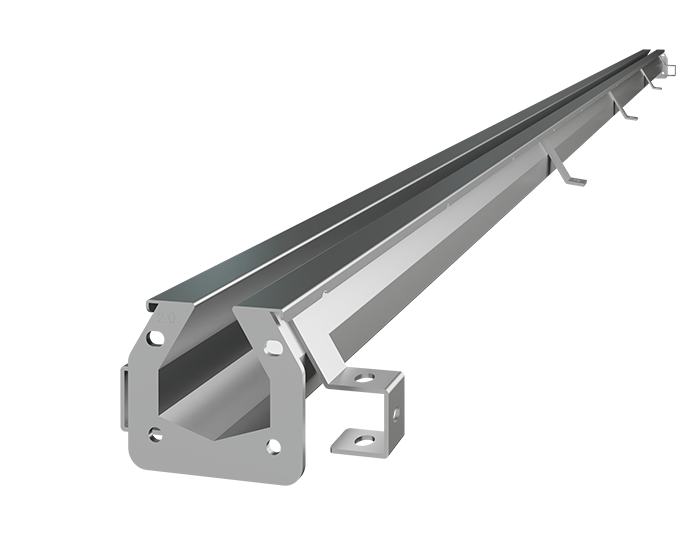
Fluid velocity and the resulting wall shear stress decay exponentially as they approach the vertex of a sharp angle, rendering fluid-based cleaning ineffective in that space. To allow the kinetic energy of fluids within the drain to scour the surface all internal corners must feature a defined, sweeping geometric radius.
Advanced drainage systems utilize specially engineered internal geometries to physically induce a dynamic vortex. By leveraging a rounded drain body, the system generates a powerful rotational flow. This rotational vortex combines with surface tension to create an effect, where water clings to the inner radius of the drain body to drive debris and particulates into a centralized flow. This self-cleaning phenomenon is commonly known as ‘the teapot effect’ and is found in advanced drain body designs.

Selection of Non-Porous and Chemically Inert Substrates
The foundation of any hygienically designed system is the chemical and physical composition of the materials used for its fabrication. The chosen substrates must be completely non-porous and chemically inert.
Any microscopic porosity provides an immediate, sheltered anchoring point for bacterial adhesion, accelerating the formation of resilient biofilm matrices. Furthermore, these materials must indefinitely withstand the severe chemical and thermal degradation inflicted by aggressive Clean-In-Place (CIP) detergents, hot water washdowns, and the corrosive nature of the food products themselves.
Stainless Steel Metallurgy
Austenitic stainless steel remains the baseline material for sanitary equipment due to its durability and cleanability. However, the specific grade of steel is highly dictated by the operational environment.
While Grade 304 is frequently utilized for neutral products and general applications, it is susceptible to pitting and corrosion when exposed to chlorides, heavy salts, and specific sanitizers.
For highly aggressive processing environments, 316 stainless steel is strictly mandated. Grade 316 contains the critical addition of molybdenum, which exponentially increases the metal's resistance to chloride-induced stress corrosion cracking and allows it to maintain structural integrity even during extreme temperature fluctuations.
Failure to utilize the correct alloy results in surface cracking or pitting which subsequently transforms a smooth surface into an un-cleanable harbor for pathogens.

Resinous Flooring
The mandate for non-porous, chemically inert materials extends beyond the processing equipment to the environmental infrastructure itself, specifically the flooring. Concrete is inherently porous and an unacceptable surface in high-risk zones.
To seal the environment, seamless resinous coatings are applied. Polyurethane and epoxy formulations maintain a critical degree of elastomeric flexibility, allowing them to absorb heavy physical impacts and withstand the thermal shock associated with high-volume hot water washdowns.
By utilizing chemically inert materials engineers create a macro-geometry that aggressively rejects both chemical degradation and biological colonization.
Sanitary Welding
The integration of disparate metallic components introduces the highest risks of geometric disruption in any sanitary system. In hygienic drainage, permanent joints must be created via precision welding, as mechanical fits, threaded connections, or chemically bonded joints present severe, long-term contamination risks due to microscopic gaps.

To qualify as a sanitary joint, the weld must achieve 100% full penetration, reaching completely through to the other side to create a perfectly flush, seamless structural joint.
The completed weld must be free of burns or sugaring as well as smooth and continuous with no undetectable undercutting or porosity to prevent bacterial anchoring.
Accessibility for inspection, cleaning and maintenance.
Uninspected, uncleaned drains can rapidly aerosolize pathogens into the broader processing environment during washdowns or act as hidden breeding grounds for pests.
The hygienic integrity of a food manufacturing facility relies heavily on the accessibility of its drainage system for routine inspection, cleaning, and maintenance. If a drain's internal geometry cannot be easily reached or visually assessed, it inevitably becomes a permanent harborage site for resilient biofilms.
Accessible drainage systems have lids and grates that are easy to remove giving access to the internal geometry of the drain. Drains must provide unobstructed access for cleaning and visual inspection. Allowing staff to verify the removal of solids and biofilms.
Catch basins play an important role in the accessibility and maintenance of linear drainage. Providing an access point for the inspection of the internal geometry of slot drains and trench drains. Catch basins also provide an access point for inspections of plumbing and piping.
Drains with lids or grates that are sealed shut should be avoided. Placement of drains should enable easy daily inspections by staff. Equipment and machinery should not be placed over drains except where the drain provides dedicated drainage.
Hygienic Geometry Future-Proofs Facilities
Hygienic geometry is more than an aesthetic preference or a subjective industry practice; it is a quantifiable, mathematically governed, and rigorously enforced engineering discipline that serves as a primary physical barrier against contamination in sensitive manufacturing environments.
By translating complex microbiological imperatives directly into strict, unyielding geometric constraints engineers systematically eliminate the environmental niches required for deadly pathogens to survive.
The continuous harmonization of these engineering standards drives intense innovation across the drainage manufacturing sector, pushing the industry relentlessly toward designs that are intrinsically self-draining, flawlessly welded, and fully accessible.
The meticulous application of true hygienic geometry delivers a massive return on investment, ensuring product safety while simultaneously maximizing operational efficiency, and long-term enterprise profitability.